China's automotive industry is moving from selling products to selling solutions, and a growing number of global carmakers are turning to Chinese technology for batteries and intelligent driving. According to the Chinese outlet D1EV, the shift is driven by China's ability to solve common global problems, backed by large-scale real-world validation and a systematic output capability.
In the era of combustion engines, technology routes were defined by Europe, the US, and Japan, with patents on engines, transmissions, and chassis held by foreign firms. China could only trade market access for technology, doing assembly and localized adaptation. But with electrification and intelligence reshaping the technical foundation, new fields like power batteries and autonomous driving lack entrenched patent moats, giving Chinese players a rare opportunity to define global standards.
Batteries and smart driving lead the charge
Power batteries are a common bottleneck for global electrification, facing constraints on cost, safety, energy density, fast charging, and supply chain stability. According to corporate disclosures and SNE Research data cited by D1EV, CATL shipped 464.7 GWh of batteries in 2025, holding a 39.2% global market share and ranking first for nine consecutive years. Chinese battery makers together account for over 70% of the global market. CATL's success lies in balancing cost and energy density in LFP (lithium iron phosphate) chemistry to a level acceptable to global automakers.
In smart driving, Chinese firms are also entering global supply chains. Momenta has joined the supply chains of Mercedes-Benz and BMW: Mercedes' new electric GLC SUV uses Momenta's reinforcement learning large model, while BMW's next-generation iX3, i3, and new 7 Series feature a Level 2 navigation assistance system co-developed with Momenta. Huawei's Qiankun has partnered with Audi, making the new Q5L the world's first luxury combustion SUV to feature Huawei's intelligent driving technology. These collaborations, according to D1EV, stem from overseas automakers' inability to match the same driving experience.
CATL recently signed a deal with Egypt's BME to license battery pack technology and provide production equipment, helping build a 1 GWh heavy commercial vehicle battery pack plant, expandable to 5 GWh. This targets the emerging common market of commercial vehicle electrification in Africa and the Middle East.
Validation at scale
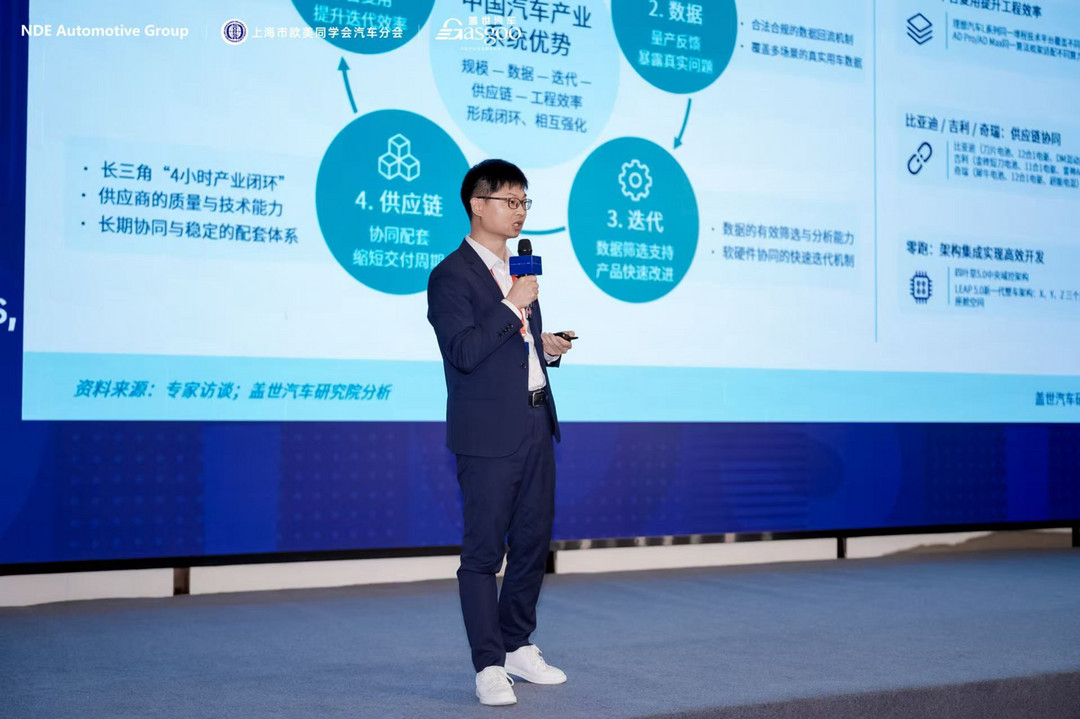
A solution's global viability depends on rigorous validation: large scale, real-world scenarios, and continuous iteration. China provides such a testing ground. According to the China Passenger Car Association (CPCA), new energy vehicles accounted for 65.2% of new car sales in August 2026. This means technologies are tested on millions of vehicles under extreme weather, complex road conditions, and diverse driving habits.
The iteration pace is rapid: Xpeng and Volkswagen's co-developed model went from launch to production in just 24 months, and Horizon Robotics' full-stack development cycle for its Journey 6M solution took only 10 to 11 months, as disclosed by a Bosch executive at the 2026 Beijing Auto Show. New revenue structures are emerging: in the second quarter of 2026, Xpeng's services and other revenue reached about 2.7 billion yuan (about $380 million), with a gross margin of 75.1%, contributing 49.6% of gross profit despite accounting for only 13.7% of revenue.
However, Chinese validation proves feasibility, not global adaptability. European regulations test data compliance, the Middle East's heat and Nordic cold test reliability, and different driving habits and traffic rules require adaptation. Some solutions optimized for China's unique road conditions, such as dense EV traffic and complex intersections, may perform poorly in European roundabouts or high-speed zones.
True global solutions must be modular and standardized, able to integrate into different countries, automakers, and regulatory systems. At the Beijing Auto Show, Horizon Robotics signed a strategic cooperation with global Tier-1 supplier Astemo, following partnerships with Bosch and Denso, embedding itself into both German and Japanese supply chains. As Horizon founder Yu Kai said, "The globalization of smart driving chips is never about exporting a single technology, but about synchronizing the technology base with the industrial ecosystem."
While Mobileye and Nvidia have long dominated, Chinese chip makers are now being accepted into core supply chains, marking a shift in global smart driving competition from individual technologies to ecosystem standards. Yet, as D1EV cautions, entering a supply chain does not guarantee irreplaceability.