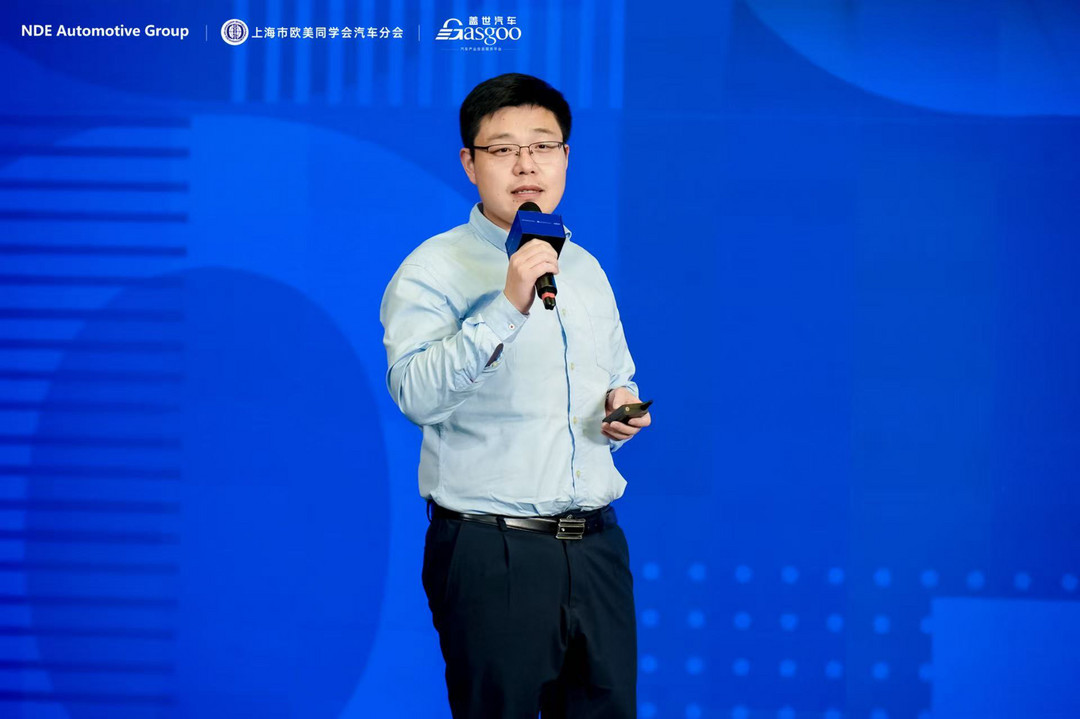
China's automotive industry must prioritize local compliance and adaptation to succeed globally, according to Wang Xianbin, vice president of the Gasgoo Auto Research Institute. Speaking at the 2026 14th Automotive and Environment Innovation Forum and the 8th Golden Award ceremony in Shanghai on October 23, Wang outlined ten key industry judgments for the coming year, as reported by D1EV.
Wang described China's approach as "fast, good, and cheap," attributing this to economies of scale. He cited vast data volumes, rapid iteration cycles, a complete supply chain, and an engineering talent dividend as the foundation of the country's engineering efficiency. He noted that competition is converging on scale, closed-loop systems, cost, and compliance, with the logic of going global shifting toward supply chain security and localization.
AI and the future of mobility
Wang argued that AI is restructuring the auto industry, with a "ChatGPT moment" already underway. Applications are penetrating cockpit systems, intelligent driving, manufacturing, and marketing. He predicted that the intelligent driving landscape will consolidate into a "1+4+2N" structure, where leading players widen their advantage. Cockpit homogenization is driving cross-industry technology integration, with high-end chips accelerating breakthroughs in cockpit domain control and autonomous driving.
He also identified intelligent chassis as entering a mass-production window for EMB (electro-mechanical brake) and SBW (steer-by-wire) systems, which could serve as the execution foundation for L3 and L4 autonomous driving. Efficient powertrains and energy management remain global challenges, he said, while the convergence of automotive and embodied intelligence supply chains has reached 60-70%, suggesting that mobile physical AI could become a second growth curve.
Localization as a competitive moat
Wang stressed that the core of China's global value proposition lies in local compliance and adaptation. Companies must convert innovative technology, talent dividends, and supply chain systems into a scalable user base for global customers. This requires aligning with regulations, data localization, and organizational capabilities, while building a collaborative innovation ecosystem through technology co-creation, systematic division of labor, and delivery fulfillment. He concluded that turning global adaptation capabilities into a competitive barrier is essential.