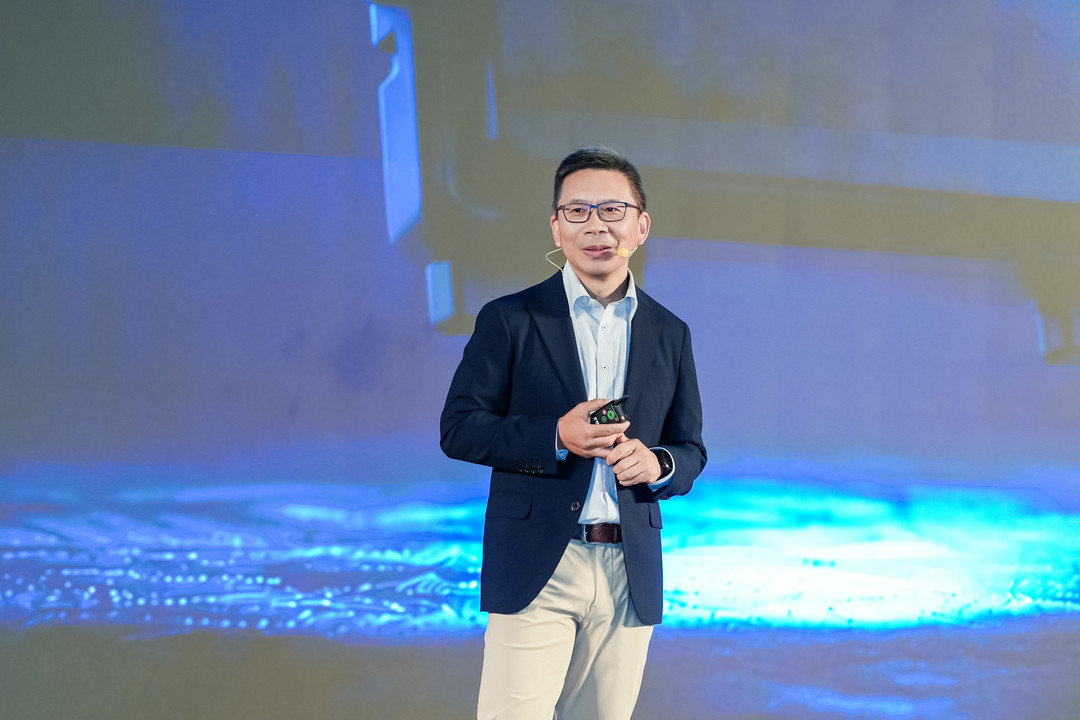
Electric vehicles are moving from “single-point breakthrough” intelligence—where assisted driving, the cockpit and the chassis each become smarter in isolation—toward a fused architecture in which one central compute platform runs the whole car. That was the argument from Liu Xiaofei, deputy director of digital energy at Seres Technology, at Gasgoo’s fourth AI-Defined Auto Forum on Sept 18, according to Chinese electric-vehicle news outlet D1EV.
Liu said the next generation of vehicles should not be “each one smart on its own” but “collaborative and fused.” This follows an industry-wide shift from distributed electronic control units (ECUs) to centralized, zonal computing platforms, a structural change that is reshaping the technology base of the industry, D1EV reported. He compared a central compute platform to the car’s “brain”: it pools computing resources from the assisted-driving and cockpit domains so data, algorithms and compute can be shared.
Mass-produced central compute is already here
Liu cited several examples of the concept moving into production. Desay SV’s integrated cockpit-and-driving solution has already been mass-produced on the Chery Fengyun T7, breaking the conventional “dual-brain” architecture in which cockpit and assisted driving run on separate hardware. Horizon Robotics’ Xingkong (Star) chip, released in April 2026, uses a 5nm automotive-grade process and delivers 650 TOPS of BPU compute, supporting both cockpit AI and high-level assisted-driving large models on a single chip as a domestic option for central compute architectures.
Seres is pursuing the same direction with its Magic Platform 2.0, an AI-driven smart electric platform whose central-compute-plus-zonal-control electrical and electronic architecture has been mass-produced in the new-generation Aito M9.
Liu compared zonal controllers to the car’s nervous system, handling command delivery and information feedback. The efficiency gains are concrete, he said: zonal integration can cut the number of ECUs by more than 50 percent, remove more than 3.5 kilometres of wiring, reduce vehicle weight by 25 to 30 kilograms, and save up to 30 percent in cost. At the software level, he proposed layered design—decoupling a device abstraction layer, atomic services, combined services and applications—to improve software reuse and shorten model development cycles. That direction, he said, matches the industry’s move from conventional layered software toward AI-native architectures.
From transport tool to “intelligent companion”
For Liu, the architecture exists to rebuild the user experience. The future car should be an “all-domain intelligent hub” and “a mobile partner that understands you,” but technology that stays in the laboratory cannot serve users. He advocates an end-cloud integrated architecture in which the vehicle handles real-time response and safety-critical operations while the cloud carries out deep reasoning and long-term planning with large models.
That approach is already appearing in the market. Neusoft Reach’s vehicle-cloud collaborative AI compute platform, Cloud OS, has been mass-deployed by several leading carmakers with cumulative installations of more than one million vehicles, scheduling cloud elastic compute and in-vehicle low-latency compute together. Visteon and Nvidia have jointly developed an edge-cloud AI arbitration architecture that dynamically distributes AI workloads between vehicle hardware and cloud infrastructure to balance real-time response, data privacy and connectivity. ModelBest and Geely co-developed an on-device multimodal large model now deployed on the Geely Galaxy M9’s intelligent cockpit, while iFlytek’s Xinghuo cockpit on-device multimodal model family offers sizes from 0.5B to 7B parameters for different compute platforms and vehicle configurations.
Liu stressed that cars must be “growable”: competitiveness depends not only on functions delivered at the factory but on how fast the car evolves after delivery. Over-the-air updates supported by zonal controllers, plus data-loop model iteration, are turning the car from a one-time transaction into an ongoing service relationship. In his view, automakers no longer face a choice of whether to fuse domains, but only of which architecture to fuse them with. The real dividing line, he said, is whether companies can turn architecture capability into a continuously improving product experience—and that competition has only just begun.