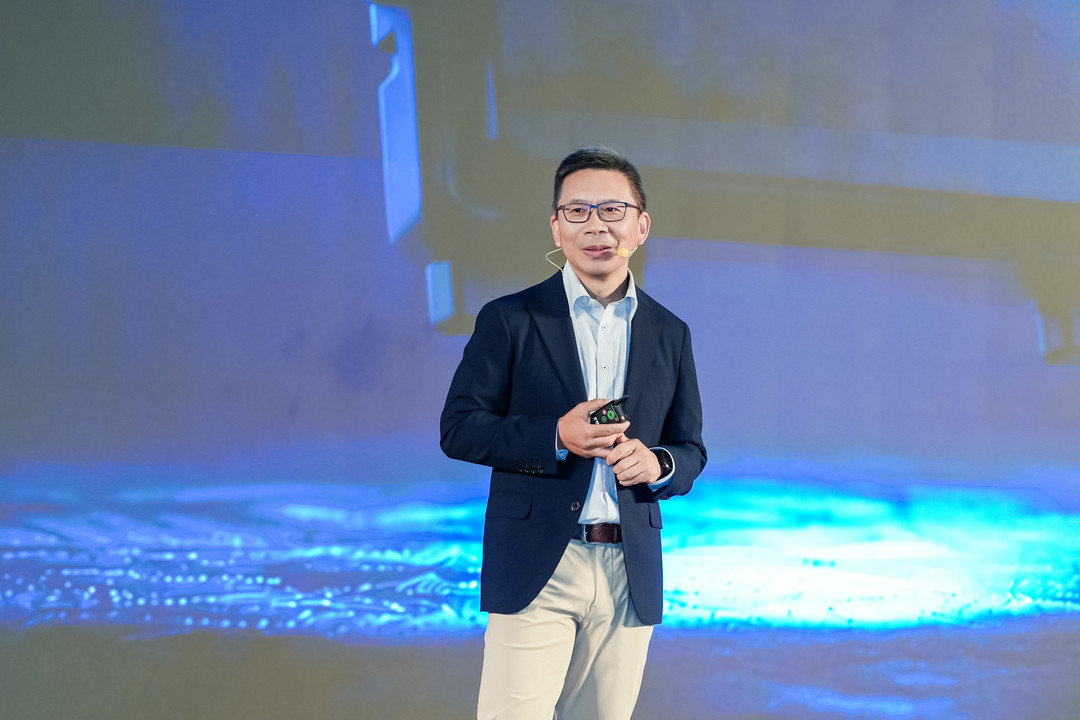
In-vehicle artificial intelligence is moving from cockpit and advanced driver-assistance systems (ADAS) toward smaller models running on zone controllers and microcontrollers (MCUs), with mass deployment expected to peak between 2028 and 2030, according to NXP Semiconductors' Liu Yuwei, product marketing manager for automotive edge AI in Greater China.
Speaking at the fourth AI-Defined Vehicle Forum organized by Gasgoo on September 18, Liu outlined NXP's edge-AI product portfolio, deployment scenarios, and toolchain capabilities. He said the company's differentiation lies in a unified, self-developed NPU (neural processing unit) IP across its entire product line, paired with a low-loss toolchain, covering vehicles from premium to budget segments.
Three high-value scenarios
Liu identified three scenarios with the most immediate deployment value: battery management systems (BMS), intelligent chassis control, and virtual sensors. These address the industry's twin priorities of performance improvement and cost reduction.
For BMS, NXP's AI approach replaces traditional equivalent-circuit plus Kalman-filter methods, improving state-of-charge (SOC) and state-of-health (SOH) accuracy from 3-5% to within 1%. The company has released open-source pre-trained models for customers to evaluate quickly. In intelligent chassis, NXP has developed a lightweight road-surface classification model with only 186K parameters, requiring just 2.2 milliseconds per inference, well within the 10-millisecond control loop requirement. Virtual sensor projects, including replacing tire-pressure and automatic headlight sensors, are nearing mass production, Liu said.
NXP's central computing platform supports task isolation across multiple domains with different functional safety levels, enabling efficient cross-domain collaboration. Its AI Box product targets existing economy-class cockpit platforms priced between 120,000 and 150,000 yuan (about $16,900-$21,100, Chinese guide price before taxes and incentives), offering a single-chip solution with 40 TOPS (trillion operations per second) of computing power, expandable to 160 TOPS, while consuming only 6.4 watts. The chip supports both independent gigabit Ethernet connection to domain controllers and an external computing card for cockpit chips.
Zone controllers and toolchain
Liu revealed that 10 of the top 14 OEMs by sales in China have explicit plans to adopt high-realtime small AI models in their next-generation architectures between 2028 and 2030. NXP's S32K5 chip family offers NPU computing power ranging from 51 to 400 TOPS, with R52 cores supporting direct deployment of floating-point models without quantization, avoiding precision loss.
NXP's self-developed toolchain handles the deployment adaptation of models trained on servers or PCs to edge devices, and includes model compression. Through mixed-precision quantization and other proprietary strategies, the toolchain keeps precision loss from converting 32-bit floating-point to 8-bit integer within 0.1%, far better than open-source alternatives, according to Liu.
In terms of model adaptation, NXP has completed work on Qwen and FaceMind models in China, and Llama and Gemini overseas, ensuring no additional adaptation barriers for customers, he said.
Liu emphasized that NXP will continue to leverage its full-product-line self-developed NPU IP and low-loss toolchain as core competitiveness to drive widespread deployment of vehicle-edge AI. The remarks were reported by Gasgoo and republished by Chinese outlet D1EV.