Chongqing, China's traditional auto-industry heartland, reclaimed the title of the country's top vehicle-producing city in 2025, but a sharp slowdown in output and a first-half loss at local champion Seres are forcing a rethink of what that title is worth. The city is now racing to transform from a volume leader into a value leader, according to a report from the Chinese outlet Huxiu.
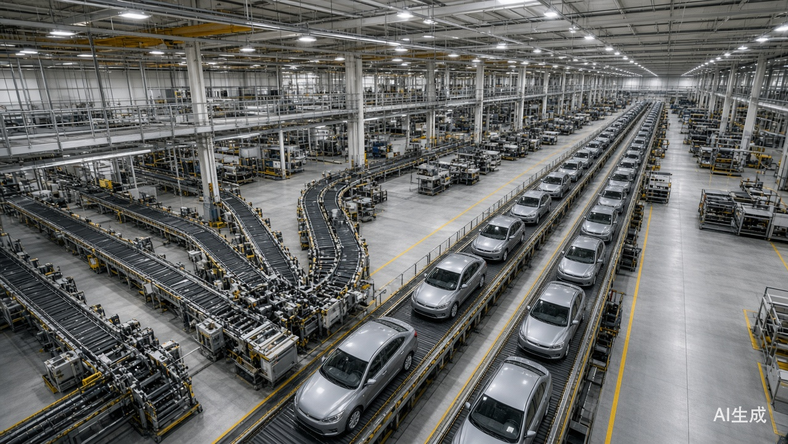
Chongqing produced 2.788 million vehicles in 2025, up 9.7% year on year, ranking first among Chinese cities and third among provinces. New-energy vehicle (NEV) output reached 1.296 million units, up 36%, and the industry cluster's scale surpassed 800 billion yuan (about $112.7 billion). The city first topped the national ranking from 2014 to 2016, peaking at 3.156 million vehicles in 2016, the only Chinese city to exceed 3 million units in a single year.
But the momentum has faded. In the first eight months of this year, Chongqing produced 1.4495 million vehicles, down 12.6% year on year, slipping from third to fifth place among Chinese provinces as Zhejiang and Jiangsu overtook it. August output fell to 168,900 units, nearly 30% below the same month last year. NEV output in the period rose just 4.2% to 721,500 units, far below the national growth rate and a sharp deceleration from the city's own 13.3% growth in 2025.
The slowdown reflects a painful transition: new-energy gains have not yet filled the gap left by declining conventional car production. A report delivered to the Chongqing Municipal People's Congress highlighted structural weaknesses, noting that locally produced chips account for a small share of supply, with over 80% of key components such as automotive-grade chips and high-precision sensors dependent on external suppliers. The localization rate of in-vehicle operating systems is below 15%, according to the city's economy and information technology commission.
Seres' pivot after Huawei tie-up shifts
Local champion Seres is also under pressure. In the first half of this year, the company swung to a net loss of 1.717 billion yuan (about $242 million) on revenue of 57.493 billion yuan, down 7.87% year on year. It was Seres' first half-year loss after two consecutive profitable years; in the same period last year it posted a net profit of 2.94 billion yuan. The company attributed the decline to a product transition period for its main models, rising prices for batteries and chips, and asset impairment charges.
Seres' August sales fell sharply, with NEV deliveries down 43.96% year on year to 24,244 units. Cumulative deliveries for the first eight months dropped 12.58% to 227,250 units. The decline comes as Seres and Huawei restructure their cooperation. On September 15, Harmony Intelligent Mobility Alliance and the AITO brand announced a new cooperation model under which Seres will take the lead on product definition, design, brand marketing, channel retail and service systems, with Huawei's terminal business providing support.
Huawei's Richard Yu said Seres had grown significantly through the partnership and that Huawei supports the company's desire to take the lead. The shift is seen as helping Seres strengthen its manufacturing and operations advantages and accelerate overseas expansion. The restructuring follows years of debate in China's auto industry about whether automakers should cede control to Huawei, exemplified by SAIC's former chairman Chen Hong's famous 2021 remark that SAIC would not accept a single supplier providing a complete solution, saying "our soul must be in our own hands."
From volume to value
Chongqing's mayor, Chen Xinwu, visited Seres in late September, emphasizing government-enterprise cooperation to support the company's high-quality development and build the city into a "capital of intelligent connected new-energy vehicles." The city first outlined this ambition in 2018 and formalized it in 2024, leveraging its hilly terrain, bridges, tunnels and foggy weather as a natural testing ground for intelligent driving. By 2025, the city had achieved full coverage of 3 major systems, 12 assemblies and 56 components for intelligent connected NEVs.
The city's goal is to produce 2 million NEVs by 2027 and build a trillion-yuan industry cluster. But officials acknowledge that the key is not just building more cars, but competing on chips, algorithms, software, data, brands and ecosystems. The average price of NEVs produced in Chongqing rose from 236,000 yuan (about $33,200) in 2024 to 240,000 yuan (about $33,800) in 2025, but remains below the average in Shenzhen and Shanghai, indicating room for premiumization.
The report urged strengthening leading enterprises such as Changan, Seres and Qianli Technology to enhance industrial chain control. For Chongqing, 2027 is the critical juncture to shift from "high output" to "strong industry." The city's "auto capital" title, once a measure of scale, is now being tested by its ability to create value.