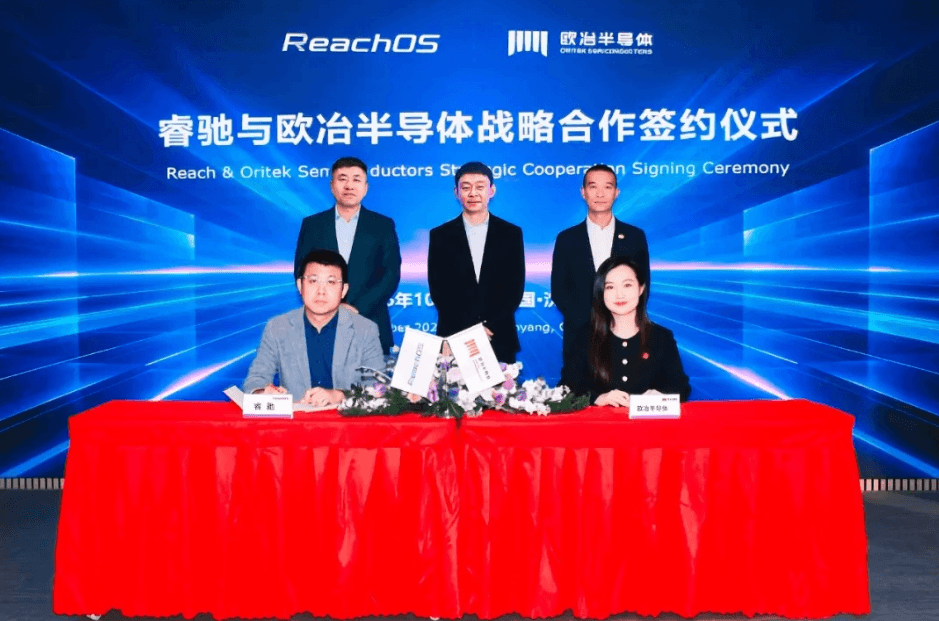
Chinese chipmaker Ouye Semiconductor and software firm Reach Auto have signed a strategic cooperation agreement to jointly develop regional controller (ZCU) solutions for smart vehicles, according to Chinese outlet D1EV. The partnership aims to combine Ouye's Gongbu 565 series chips with Reach's NeuSAR basic software platform to create an integrated "domestic chip + domestic software" offering, accelerating the shift to next-generation electronic and electrical (E/E) architectures.
The automotive industry is rapidly moving from distributed control to a "central computing + zonal control" architecture, where ZCUs serve as the critical link between the central compute platform and vehicle actuators. The maturity and localization level of ZCUs have become key factors determining the pace of architecture upgrades. Under pressure from supply-chain security, cost control, and customization needs, China-made "chip-software integrated" solutions are moving from optional to essential for automakers.
Technology highlights
Reach Auto claims to be the first in China to achieve mass production of a full-stack software platform covering AUTOSAR CP, AP, and middleware. Its NeuSAR cCore basic software complies with AUTOSAR R21-11/R23-11 standards, supports multi-core deployment, and is the first in China to receive ISO 26262 ASIL-D functional safety certification. It also follows ISO/SAE 21434 for cybersecurity, supporting the "central computing + zonal control" architecture across functional modules, safety levels, and performance.
Ouye Semiconductor's Gongbu 565 series is described as China's first high-end ZCU main control chip designed for third-generation E/E architectures. Using a "1+3" architecture, it upgrades the ZCU from a traditional multi-protocol signal relay to a regional intelligent hub with high-performance routing, edge computing, real-time communication, and smart power management. The chip is the first in China's automotive-grade segment to mass-produce with RRAM (resistive random-access memory) technology, and it includes an AI acceleration engine. In areas like TSN hard-forwarding latency, AI computing power, and interface richness, it reportedly surpasses international mainstream products.
Executives weigh in
Xing Zhigang, senior vice president and senior partner at Reach Auto, said the partnership is crucial as China moves from a large automotive country to a strong one. "New energy vehicle penetration continues to rise, and vehicle exports grow steadily. Breaking through with an independent supply chain is especially critical," he said. The two companies aim to combine high-end domestic automotive chips with full-stack basic software, creating competitive ZCU solutions and accelerating mass production, while also expanding to other intelligent terminal scenarios and global markets.
Zhou Difei, founder of Ouye Semiconductor, said the Gongbu 565 is not just an automotive chip but transforms the ZCU into a regional intelligent agent with local AI capabilities. "This is a large-scale implementation of embodied intelligence in the physical world," he said. He hopes the cooperation goes beyond a single ZCU solution to define new forms of intelligence and build an open, reusable intelligent foundation that can extend from cars to robots and other physical scenarios.
Going forward, Ouye Semiconductor and Reach Auto will deepen technical collaboration and market coordination, leveraging their industry insights and experience to define next-generation basic software products and vehicle chips, and to expand into more intelligent terminal and equipment scenarios. The goal is to build an autonomous, open, and win-win automotive electronics ecosystem.