NOR flash memory, a key component in automotive electronics and industrial controls, is undergoing its most significant supply-demand shift in nearly a decade, according to a new forecast from market research firm TrendForce. The firm said that capacity growth measured by bit count will be limited in the second half of 2026, and prices for high-capacity products could double again.
Why supply can't keep up
Although suppliers have increased capital expenditure and expanded production, new capacity cannot immediately translate into market-ready supply. TrendForce points out that new output must go through process shrinking, yield ramp-up, product validation, and customer specification integration, meaning the gap in the mid-to-high capacity segment will remain unfilled in the short term.
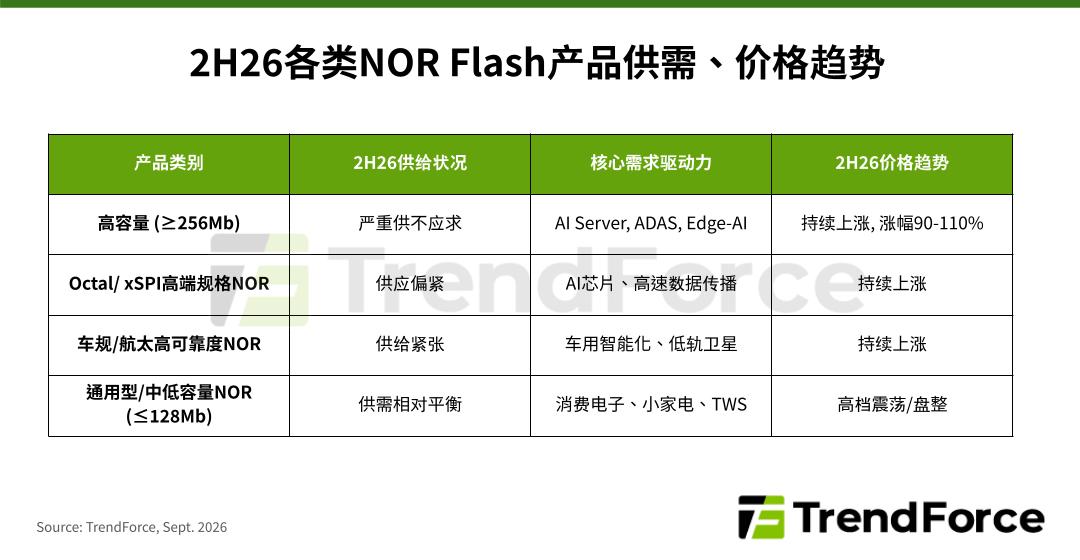
The shortage is not just a cyclical blip. Traditional demand from automotive ADAS (advanced driver-assistance systems), digital cockpits, and industrial control is being supplemented by new drivers: artificial intelligence and aerospace communications. AI servers require significantly more NOR flash than traditional servers, as many retimers (signal repeaters) need accompanying NOR storage. NOR is also well-suited to the high-reliability storage needs of the aerospace communications industry.
Price outlook and market impact
TrendForce forecasts that in the second half of 2026, NOR flash price trends will diverge by capacity, with high-capacity products seeing price increases of 90-110%. This follows a period of already elevated prices, and the firm suggests that the market could see another doubling in high-capacity segment prices if supply constraints persist.
The forecast is part of a broader series of reports from TrendForce, which also tracks top chip designers and wafer foundries. In the second quarter of 2026, the top ten chip design companies saw revenue grow 73% year-on-year, and the top ten wafer foundries generated nearly $53.49 billion in combined output, both record highs.
For the electric vehicle industry, NOR flash is a critical component in infotainment systems, instrument clusters, and ADAS modules. Any prolonged price increase could add to the bill of materials for automakers, potentially affecting vehicle pricing. However, the impact is likely to be more pronounced in high-end models that use larger NOR capacities for advanced features like over-the-air updates and complex driver-assistance functions.