
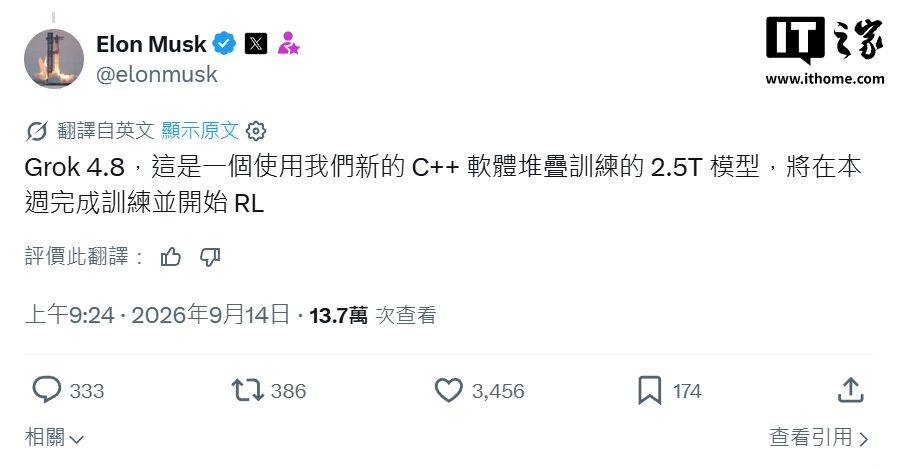
Elon Musk said Grok 4.8, the next large language model from his AI company xAI, will complete training this week and move into the reinforcement learning (RL) phase, according to IThome. The model will have 2.5 trillion parameters and is being trained on a new C++ software stack, Musk said in a post on X.
Training timeline and technical shift
The announcement comes as xAI pushes ahead with rapid iteration of its Grok series. Musk said Grok 4.8 will finish training within the current week, after which the company will begin reinforcement learning to refine the model's responses. The switch to a C++ software stack marks a notable engineering change from earlier iterations, potentially improving training efficiency and scalability for the massive parameter count.

The update follows plans for Grok 4.7, which Musk had earlier said would be released on September 12. He later indicated the release might slip by a few days. The delay, according to Musk, could stem from a penalty in the reinforcement learning process that over-punishes long responses, causing the model to give up prematurely on difficult tasks and fail to rigorously check its own work.

Industry context
Grok's development comes amid broader moves in the AI sector. Microsoft has announced it will integrate xAI's Grok models into its Office suite, giving users an alternative to OpenAI's models. Meanwhile, Anthropic CEO Dario Amodei has called for a slowdown in frontier AI development, a stance that has drawn support from Musk and OpenAI's Sam Altman.
Musk also recently addressed a fatal Tesla crash in New York, denying that Autopilot was involved and criticizing traditional media outlets such as ABC for what he called a deliberate attempt to tie the incident to Tesla.
For readers tracking AI progress, Grok 4.8's completion would mark one of the largest open-weights-style models to date, though xAI has not yet confirmed release dates or access details. The C++ training stack could also signal a broader industry trend toward lower-level programming for performance gains in large-scale model training.