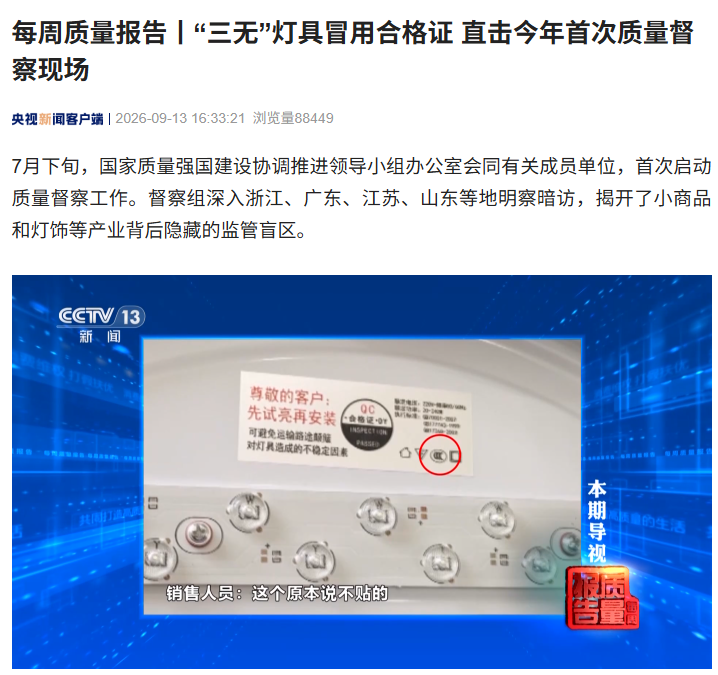
China's first national quality inspection campaign has uncovered widespread violations in the lighting industry in Zhongshan, Guangdong province, a region that accounts for over 60% of the country's civilian lamp sales. According to IThome, inspectors posing as consumers visited several lamp markets in the city and found small businesses selling products without proper factory names, addresses, or valid CCC certification.
The CCC mark, which stands for China Compulsory Certification, is a mandatory safety certification for products connected to 220-volt mains electricity. Lamps and ballasts are on the national certification list, and products without valid certificates cannot be legally sold. The inspection team, launched in late July by the national quality watchdog, found that some businesses were using fake company names, reusing cancelled certificates, or simply omitting key information from packaging to avoid traceability.
Fake certificates and phantom factories
At a workshop in Guzhen town, inspectors opened 27 boxes of lamps labeled as classroom lighting for eye protection. Although the products bore CCC marks, the company could not provide valid certificates, and the labels, certificates, and outer packaging lacked any factory name or address—a classic "three-no" product. Another 11 boxes of LED panel lights had the same issues, with packaging listing two company names, one of which, "Zhongshan Heyi Lighting Factory," did not exist in the national enterprise credit registry.
Separately, inspectors followed a tip to Guangdong Yixun Lighting Co., whose CCC certificate had already been revoked by the certification body. Despite the revocation, workers were still assembling lamps in the factory, and finished goods were stored in the warehouse. Under Chinese regulations, products cannot be shipped or sold once a certificate is revoked, and the company must reapply and pass new testing before resuming sales.
Thousands of products fail tests
Local authorities conducted random checks on 19 batches of products from Yixun, and 18 batches—totaling 1,430 items—failed quality tests. The company has been issued an administrative penalty order, with non-compliant lamps confiscated and fines imposed. The inspection team has handed its findings to Zhongshan authorities, who have opened investigations into all implicated parties and launched a special campaign to clean up the lighting industry.
The national campaign, organized by the office of the State Council's quality-strengthening group, found 153 problem leads across several provinces, including safety helmet makers in Zhejiang using recycled materials for load-bearing parts and construction material firms in Shandong with poor raw material management. All have been referred to local regulators for action.
Consumers can verify CCC certificates through the national certification information platform, checking whether a certificate is valid and matches the product model. Legitimate lamps should clearly display the factory name, address, model, and CCC mark on the product or packaging. For classroom lighting, buyers should also look for compliance with the national standard for school lighting, GB 7793-2010, which covers illuminance, uniformity, color rendering, flicker, and blue light levels.