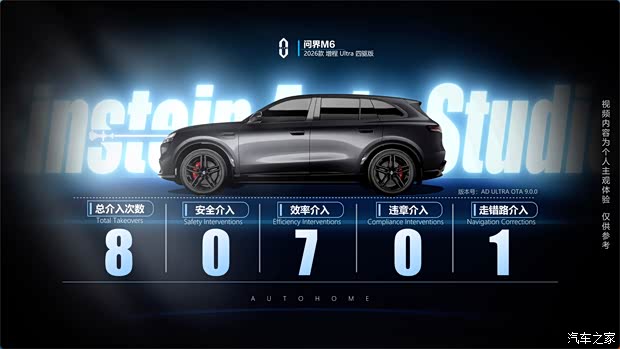
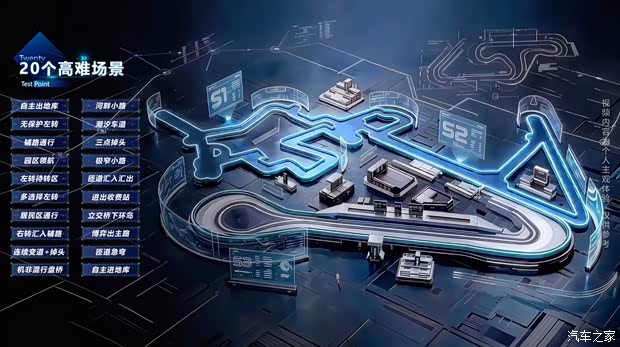
Autohome recently put the Aito M6 Extended Range Ultra through a demanding 50-kilometer (31-mile) urban driving challenge in Beijing's evening rush hour, testing the capabilities of its Huawei Qiankun ADS Max advanced driver assistance system. The route, dubbed the "Zhikao Qingbei" challenge, included 20 high-difficulty scenarios such as narrow city streets, heavy congestion, complex roundabouts, continuous U-turns, tidal lanes, elevated road interchanges, highway toll booths, and gated community roads. According to Autohome, the system required only eight driver interventions over the entire route, and none were for safety reasons.
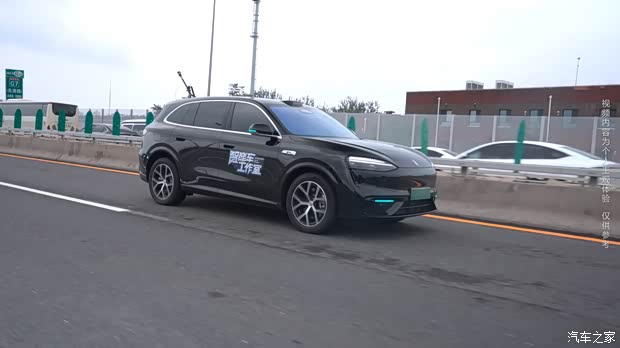
The Aito M6 Ultra, which carries a Chinese guide price of 279,800 yuan (about $39,400) before taxes and incentives, is equipped with Huawei's top-tier ADS Max package. This includes a 896-line forward lidar, a rear solid-state lidar, five 4D millimeter-wave radars, 11 cameras, and 12 ultrasonic sensors. The 896-line lidar provides point clouds four times denser than the 192-line units, allowing the system to detect low-lying obstacles at a distance more clearly. This technology was first introduced on the premium Aito S800 and Aito M9 models before being made available on more affordable vehicles.
Software and real-world performance
The software running on the test vehicle was version 4.10.3.1, based on Huawei's WEWA architecture, which combines a cloud-based world engine for simulation training with an on-board world behavior model for real-time decision-making. Autohome noted that the system's driving etiquette and efficiency balance were well managed, with the vehicle yielding when appropriate and proceeding decisively when it had the right of way. The system showed a clear preference for the leftmost lane, a logical choice for efficiency and safety, as it often provides the most direct route and keeps the vehicle away from non-motorized traffic.
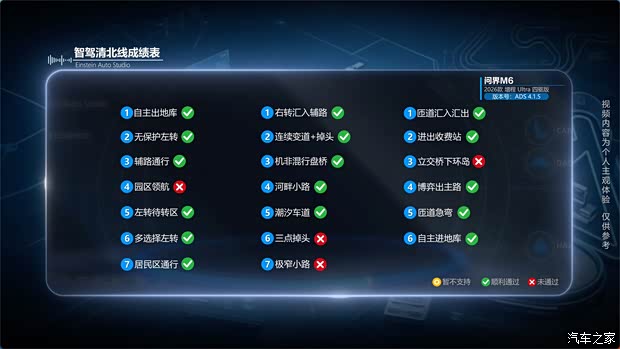
However, the test also revealed areas for improvement. The system experienced several downgrades during the route, particularly in closed parks, under overpasses, and during three-point turns. Autohome advises drivers to remain cautious in such scenarios, as the system is still a driver assistance feature and requires the driver to be ready to take over at any time.
Navigating complex scenarios
One of the standout performances was in an unprotected left turn, where the vehicle encountered a food delivery rider cutting across its path. The system had already detected the rider's trajectory and maintained a comfortable speed, completing the turn smoothly without any abrupt braking. In another test, the vehicle correctly identified a hidden traffic light at a hospital entrance and proceeded safely, avoiding a potential red-light violation.
The Aito M6 also demonstrated its ability to handle parking garage navigation, a feature that is becoming increasingly important in China. The system supports park-to-park navigation and memory parking assist, allowing drivers to activate the navigation function from their parking spot. During the test, the vehicle smoothly exited a multi-story garage, navigating tight corners and narrow ramps with confidence, as shown in the system's real-time 3D visualization.
In residential areas with narrow, two-way streets filled with pedestrians, electric bikes, and parked vehicles, the Aito M6 maintained a moderate speed and exhibited defensive driving. It proactively moved to the center of the lane to give passing delivery tricycles more space, a strategy Autohome found sensible for avoiding potential collisions and traffic congestion.
Overall, Autohome concluded that the Aito M6's ADS Max system is highly capable and safe, but it is not infallible. The frequent downgrades in certain scenarios highlight the limitations of current driver assistance technology, and drivers should remain vigilant. The test results reflect the system's performance under specific conditions and are not indicative of its absolute limits.