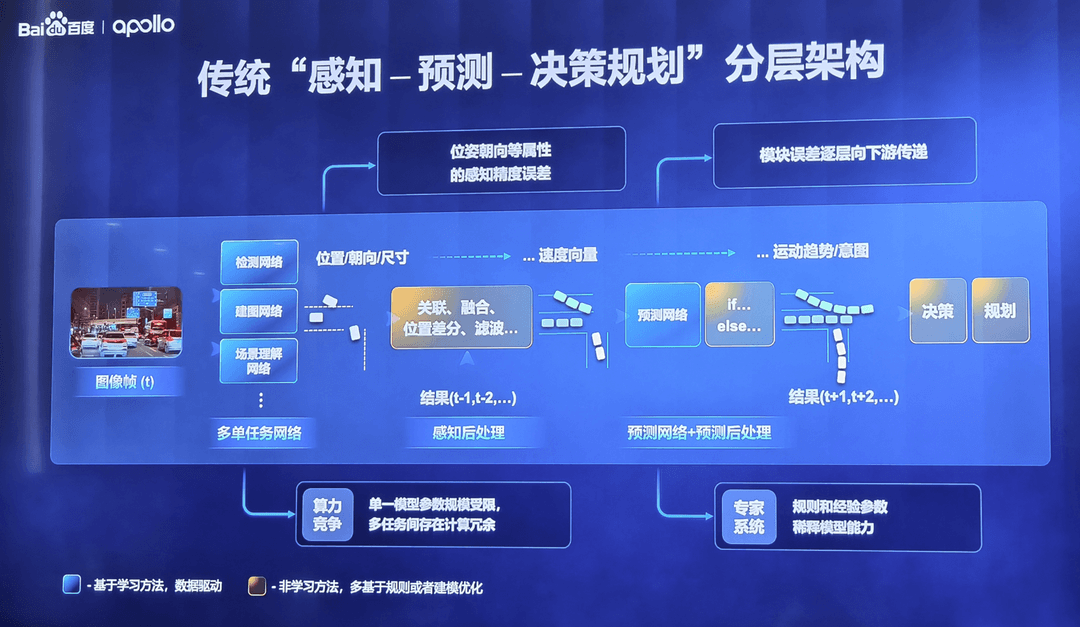
Chinese autonomous-driving companies that have not yet shifted to large-model architectures face elimination, according to DeepRoute.ai CEO Zhou Guang, whose warning has gained fresh attention after a test in which OpenAI's GPT-6 Astra drove a real car. Speaking to Chinese outlet D1EV, Zhou reiterated his 2024 prediction that the industry must transform toward large-model-driven systems or suffer a 'dimensional reduction' attack.
GPT-6's symbolic drive
In September, independent evaluator DrivingBench let four general-purpose large models—GPT-6 Astra, Claude Fable 5.1, Grok 4.6, and GPT-5.6 Sol—control a 2022 Toyota Corolla via tool interfaces on a closed 134.7-meter course that included starting, cone slalom, reversing, and parking. GPT-6 Astra completed the route on its second attempt in 5 minutes 22 seconds at an average speed of about 1.5 km/h; other models finished 6% to 45% of the tasks. The same model also topped the RoboDojo robotics simulation leaderboard without specialized robot training.
DrivingBench acknowledged the tasks were 'very simple' and lacked real-world complexity such as traffic flow or pedestrians. Still, the test marked the first time a general large model controlled a real vehicle through tool interfaces to complete a full sequence—a symbolic milestone that lends weight to Zhou's argument.
Zhou draws a parallel to the early days of GPT-2 and GPT-3, which initially seemed unimpressive but transformed the landscape within two years. He argues the same rapid evolution could apply to driving, potentially outpacing traditional ADAS routes.
China's top players are already pivoting
In the first half of 2026, Huawei held 18.1% of China's high-level ADAS market, Tesla 13.2%, and Momenta 12.2%, with the rest split among more than a dozen players. None of the leaders remain on legacy modular or rule-based architectures, according to D1EV.
Huawei's Qiankun division launched ADS 5 in April under its WEWA 2.0 architecture, describing a shift from rule-driven systems to an 'AI agent for autonomous driving,' with cloud-side world models using multi-agent game theory and online reinforcement learning. The company raised its 2026 R&D budget for Qiankun from 18 billion yuan to over 19 billion yuan (about $2.7 billion), and cumulative installations surpassed 2 million units by August.
Momenta, which listed on the Hong Kong Stock Exchange in July, unveiled its R7 world model in April. CEO Cao Xudong said, 'Prediction is the cornerstone of intelligence evolution; the core of physical AI lies in deep understanding of basic physical laws.' The company has accumulated over 13 billion kilometers of real-world driving data and more than 100 million golden training segments from 800,000 production vehicles.
Tesla's supervised FSD became available in China on May 21, 2026, with a one-time purchase price of 64,000 yuan (about $9,000); overseas markets moved to a $99-per-month subscription in February, but China's subscription launch date remains unannounced.
DeepRoute.ai has chosen a foundation-model approach rather than a world model. Zhou explained that generative tasks do not require massive parameter counts, comparing it to human brain evolution: 'Humans evolved language only after a long time, needing 1,500cc of brain capacity; most animals manage with two milliliters.' He sees VLA (vision-language-action) as a subtask of foundation models, not the end goal.
Three open questions divide the industry: parameter size and architecture, the weight of data flywheels, and commercialization pace. Zhou's 'two-to-three-year window' aligns with key milestones: China's first mandatory L3/L4 safety standard (GB 44721-2026) takes effect July 1, 2027; Robotaxi fleets are scaling; and consumer willingness to pay for ADAS is being tested by FSD's 75% overseas subscription rate and China's 64,000-yuan buyout option.
'2027 is the key year,' Zhou said, predicting that clearer answers will emerge by mid-2027 as L3-compliant models launch, Robotaxi cities expand, and next-generation models hit the market.