Twenty-five Fields Medal winners, including Terence Tao, Yu Deng, and Peter Scholze, have signed a joint statement warning of a "severe misalignment" between the goals of AI companies and the mathematical community, according to IThome.
AI's Growing Role in Mathematics
The statement, titled "A Severe Misalignment of AI in Mathematics," notes that large language models have made significant strides in solving major open problems in mathematics. However, the push by AI companies to use mathematical problems as benchmarks is deemed harmful to the mathematical sciences and community. The signatories argue that the objectives of AI companies are misaligned with those of mathematicians, reflecting broader alignment issues affecting other scientific and creative professions.
The statement emphasizes that mathematics is about understanding shapes, numbers, and natural structures, built over generations through complex ideas and methods. Modern technology and science rely on these mathematical tools. The mathematical community, like humanity, values skill development and the transmission of ideas through lectures, discussions, and careful writing—processes that require time and human interaction.
Recent successes of AI in solving math problems have made headlines, but the statement warns that problem-solving is merely a tool for achieving conceptual understanding and insight. Forgetting this could lead to tools being misused. The rapid production of true/false statements may damage the fertile ground of mathematical thought rather than nurture new ideas.
Concerns Over Publication and Attribution
The signatories express concerns that AI-generated solutions are often published hastily, without proper formal writing or time to isolate new methods and ideas, or to cite related work. This raises serious issues of attribution and plagiarism, akin to other creative professions. Furthermore, without mathematicians willing to take responsibility for developing and integrating AI-conceived ideas into the mathematical canon, the crucial human chain of transmission is lost.
The statement highlights a general threat to intellectual work, where AI systems can directly produce outputs that traditionally required years of training to develop understanding and the ability to pose new questions. The mathematical community faces challenges similar to those in other scientific and creative fields, reflecting a broader societal issue: ensuring that as AI transforms work, we do not forget the original purpose of that work.
Despite these concerns, the signatories acknowledge AI's potential to enhance and accelerate genuine mathematical learning and understanding. The outcome—whether beneficial or disruptive—depends on decisions made by those controlling this technology. The statement calls for urgent action among mathematicians, AI companies, and society at large.
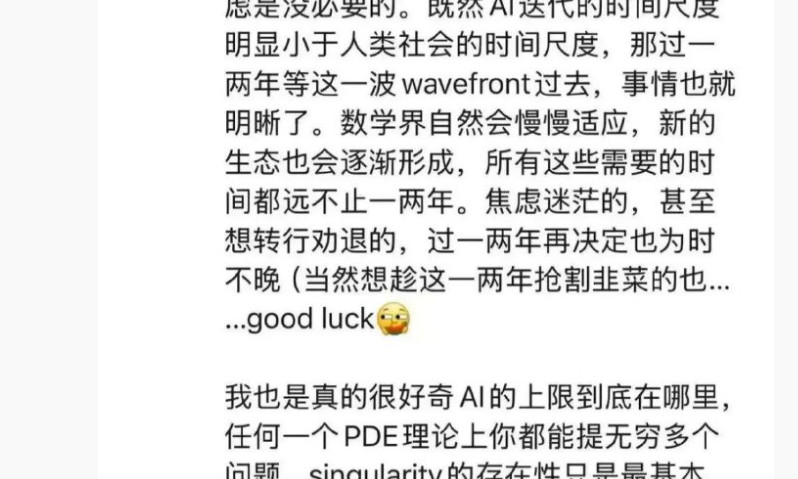
In a separate report by the South China Morning Post, Fields Medalist Yu Deng commented on the current atmosphere in the mathematical community, describing it as restless. He joked about retiring to write a yuri novel if AGI could solve all math problems, but later clarified that he was joking and does not believe AI will reach that level, at least not for the problems he mentioned.
Based on reporting by IT之家. Edited and published in English by geisou.