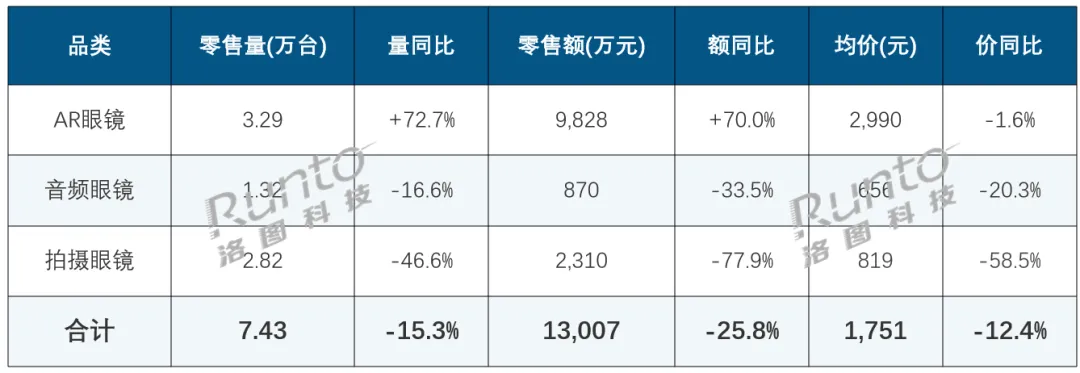
China's online smart glasses market saw its first-ever year-on-year sales decline in July, according to a report from market research firm Luotu Technology. The three major e-commerce platforms — JD.com, Tmall, and Douyin — recorded combined retail sales of 74,000 units, down 15.3% from a year earlier and 20.9% from June. Retail revenue fell even harder, dropping 25.8% year-on-year to 130 million yuan (about $18.3 million), a 43% decline month-on-month.
The slump follows a record-breaking June, when the annual "618" shopping festival drove the highest monthly sales in 13 months, according to Luotu. July last year was the second-highest month, creating a tough comparison base. The firm attributed the pullback to demand exhaustion after the promotional period and normal seasonal patterns.
AR glasses shine amid price erosion
Behind the overall decline, the market is splitting sharply by product type. The average online selling price fell 12.4% year-on-year to 1,751 yuan (about $247) in July, dragged down by an influx of low-cost devices. But AR glasses — those with both a display and audio — carved out their own growth trajectory, boosted by product refreshes and AI features.
AR glasses sales online reached 33,000 units in July, up 72.7% year-on-year, with revenue of 98.28 million yuan (about $13.8 million), a 70% increase. The average price held steady at 2,990 yuan (about $421). In contrast, audio-only glasses (no display) saw units fall 16.6% to 13,000, with revenue down 33.5% to 8.7 million yuan (about $1.2 million), as average prices dropped 20.3% to 656 yuan (about $92).
Camera-equipped glasses (no display) suffered the steepest decline: units fell 46.6% to 28,000, and revenue plunged 77.9% to 23.1 million yuan (about $3.3 million), with average prices collapsing 58.5% to 819 yuan (about $115).
Brand rankings shift
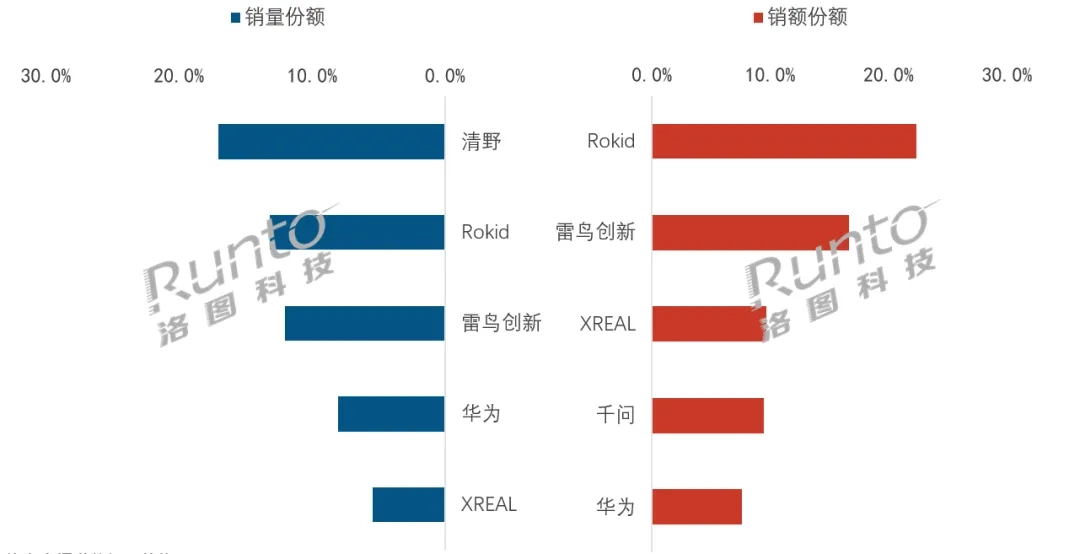
In the competitive landscape, newcomer Qingye took the top spot by unit sales in July, capturing 17.0% of the market with its budget-friendly camera glasses. It was followed by Rokid, Thunderbird (Lei Niao), Huawei, and XREAL. The top five brands together held a 55.8% combined share (CR5).
By revenue, Rokid led with a 22.3% share, ahead of Thunderbird, XREAL, Qianwen, and Huawei, with the top five accounting for 65.8% of the market. The data underscores how AR glasses are becoming the premium growth segment, while simpler devices face a price war, according to Luotu Technology.