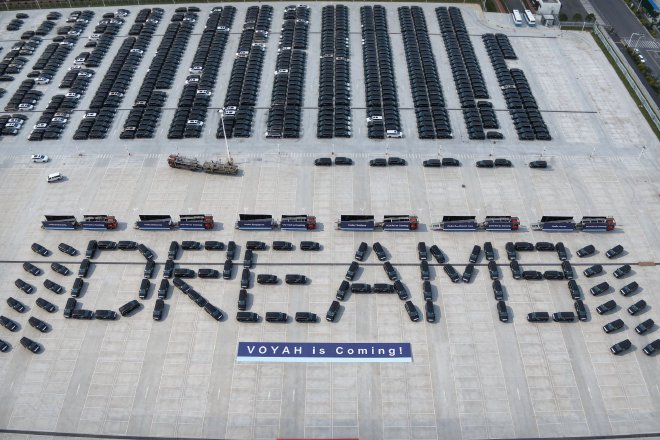
Chinese automakers are being told to abandon the export-first model that drove their rapid overseas expansion, as tariffs, quotas and local-content requirements tighten across key markets. The warning came at the 2026 Global Chinese Automotive Elite Annual Meeting, where industry leaders argued that selling more cars abroad is no longer enough.
According to the Chinese outlet D1EV, China's auto exports could exceed 11 million vehicles this year and may approach 12 million. Xu Haidong, deputy chief engineer of the China Association of Automobile Manufacturers, recalled that exports stood at just 995,000 vehicles in 2020, crossed 2 million in 2021, 3 million in 2022 and 4 million in 2023, reaching 7.09 million last year.
The overseas push has become critical to the industry's survival. In the first three quarters of this year, domestic sales fell about 22% year on year, while exports grew about 66%, according to CAAM data. But Zhao Fuquan, a professor at Tsinghua University and honorary president of FISITA, said equating going global with selling more vehicles abroad is a "primary level" approach.
Trade barriers tighten
Zhao pointed to the limits of the trade model. Global passenger car sales are about 75 million units annually, with China taking about 20 million and the US about 15 million, a market largely closed to Chinese brands. That leaves only about 40 million units accessible, and Chinese automakers are already shipping more than 10 million vehicles a year into that space.
Barriers are tightening in sequence: tariffs, then quotas, then local-content rules. Xu's data on exports to Europe shows the pressure: about 100,000 BEVs (battery-electric vehicles) were exported to the EU in 2024, rising to about 300,000 in 2025 and 490,000 in the first eight months of this year, with a full-year total expected around 800,000.
After EU anti-subsidy tariffs took effect, the additional rates vary sharply by company. Xu said the highest anti-subsidy rate reaches 45%, and with the 10% base tariff, some companies face combined duties above 50%. PHEVs (plug-in hybrids) are also being drawn into quota negotiations.
Beyond tariffs, Zhao warned of longer-tail problems. Parts clearance in some markets takes a long time, and without parts, repairs suffer. New-energy vehicles also face a lack of insurance products and weak residual-value management, each of which can offset upfront cost advantages. He also noted that quality issues with some Chinese cars have already created negative impressions overseas, and the window for cooperation with local partners is shorter than many expect.
From localisation to globalisation
Zhao cautioned against copying the playbook of traditional multinationals, noting that foreign brands once dominant in China are now retreating. He described the old model as "old bottles without new wine" and urged Chinese companies to find a new model suited to the new auto industry.
He outlined three stages of going global: trade exports, localised operations and global operations. These are not replacements for each other, he said, but production localisation is only the "primary level." The real goal is global integrated operations, where a group strategy coordinates common capabilities while regional units retain flexibility.
Key tensions include balancing headquarters control with regional autonomy, and using globally reusable platforms rather than developing unique products for small markets. Zhao said the new car is becoming a "local ration ticket" because future vehicles depend on local data, ecosystems and scenarios, making localisation a necessity rather than a cost choice.
He also argued that joint ventures are an underused card. In the new era, "reverse joint ventures" can work, with flexible shareholding structures. He cited a case where a Chinese automaker partnered with a French company, with the foreign partner holding 51% and the Chinese side 49%. Zhao defended the arrangement, saying the foreign partner's local channels and resources justify a larger stake, and letting it "do more work and earn more money" helps products open markets.
Zhao's advice for different markets: segment them by the localisation support a partner can provide and the height of market barriers, and tailor strategies accordingly.