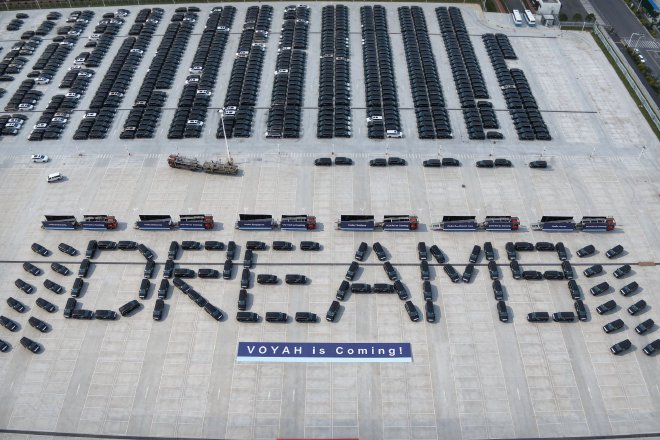
China's auto industry is moving into a new phase of overseas expansion, shifting from simply exporting vehicles to building a full supply-chain ecosystem abroad, according to Sun Xiaohong, former secretary-general of the auto branch of the China Chamber of Commerce for Import and Export of Machinery and Electronic Products (CCCME). Speaking at an industry conference in Chengmai, Hainan province, on Nov. 1, Sun outlined the goals for the country's 2026-2030 period, which he summarized as "standing firm and returning value."
During China's 14th Five-Year Plan period (2021-2025), auto exports jumped from about 1 million units to 7.89 million units in 2025, excluding low-speed electric vehicles, according to customs data cited by Sun. New-energy vehicles accounted for more than 35% of total exports, with battery-electric (BEV) passenger cars leading growth and plug-in hybrids (PHEVs) expanding in parallel. In the first nine months of 2026, exports reached 8.63 million units, up more than 50% year on year, with new-energy passenger car exports approaching 4 million units, according to the same data.
Sun said the next phase, which he called "going global 2.0," requires Chinese carmakers to defend the overseas markets they have already entered and to bring profits back to China to fund domestic research and development, creating a closed commercial loop. The focus shifts from selling products to embedding into local markets across the entire industrial chain, he said.
A tougher trade environment
Sun highlighted growing headwinds from trade policies in key markets. Brazil has restored auto tariffs to 35%, while Mexico raised tariffs to 50%. The European Union, which already imposed anti-subsidy duties on Chinese-made EVs, launched a safeguard investigation into hybrid vehicles on Oct. 30, he said. The EU's Foreign Subsidies Regulation (FSR) and Carbon Border Adjustment Mechanism (CBAM) are expected to extend to auto parts, adding uncertainty for Chinese companies operating there.
Despite these challenges, Sun said Chinese cars have gained ground in Europe. In the third quarter of 2026, Chinese brands held a 12.7% share of the EU market, surpassing Japanese brands at 11.9% for the first time, according to his presentation. Globally, China ranked second in auto export value in 2025, overtaking Japan, while Germany remained first due to higher unit prices.
Sun also pointed to structural weaknesses in Chinese carmakers' overseas operations. Their spare parts warehouses and service networks are far thinner than those of established international automakers, with parts depot counts only one-twentieth of their rivals'. He argued that relying on price competition alone is not sustainable and that the industry should shift focus to total cost of ownership management over the full vehicle lifecycle.
Outlook for 2026
Sun predicted that China's total vehicle exports could exceed 10 million units in 2026, with commercial vehicle exports reaching about 1.5 million units. He suggested leveraging Hainan's free trade port and Chengmai's location to develop new businesses such as commercial vehicle exports, battery recycling, and bonded maintenance of parts, according to the report from D1EV (First Electric).
Sun noted that global economic growth is now characterized by a three-way balance among China, the European Union, and the United States, with emerging economies growing significantly faster than developed ones. He also cited rising global economic uncertainty and faster growth in South-South trade as key factors shaping the outlook for Chinese auto exports.