
Apple researchers have published a new protein design model called SimpleDesign that can jointly generate amino acid sequences and their corresponding three-dimensional structures, according to a preprint posted on arXiv earlier this month and reported by IThome.
The model is trained directly on raw data, eliminating the intermediate representation conversion step used in traditional multi-stage pipelines. Many existing joint protein design models first train an autoencoder to convert protein structures into discrete latent representations, then train a generative model on those representations. SimpleDesign instead performs end-to-end training using amino acid sequences and continuous 3D coordinates.
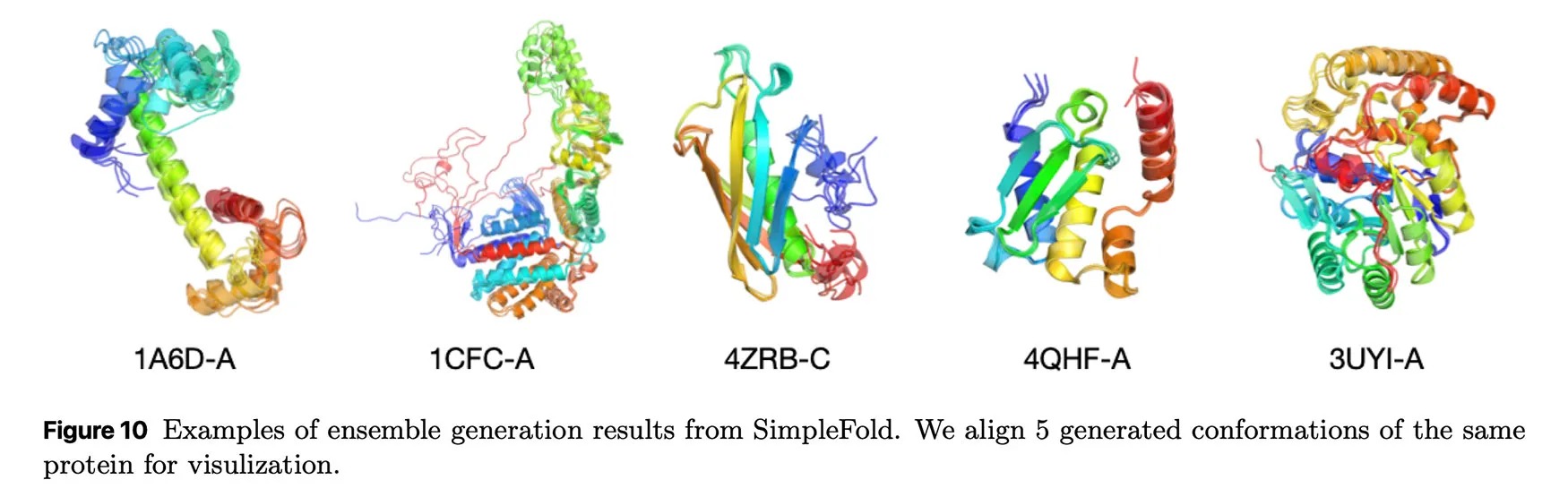
From SimpleFold to SimpleDesign
The work extends Apple's earlier SimpleFold project, which used a flow-matching model to predict protein 3D structures directly from amino acid sequences. SimpleDesign expands that simplified architecture to protein design: rather than only predicting structure, it also attempts to generate the amino acid sequences that would fold into a given structure.
The research team trained the model on more than 2 million protein sequence-structure pairs, mainly drawn from the AFESM dataset, which combines predicted structures from the AlphaFold database with other samples. During training, the model randomly masks parts of the amino acid sequence while adding noise to the corresponding 3D structure.
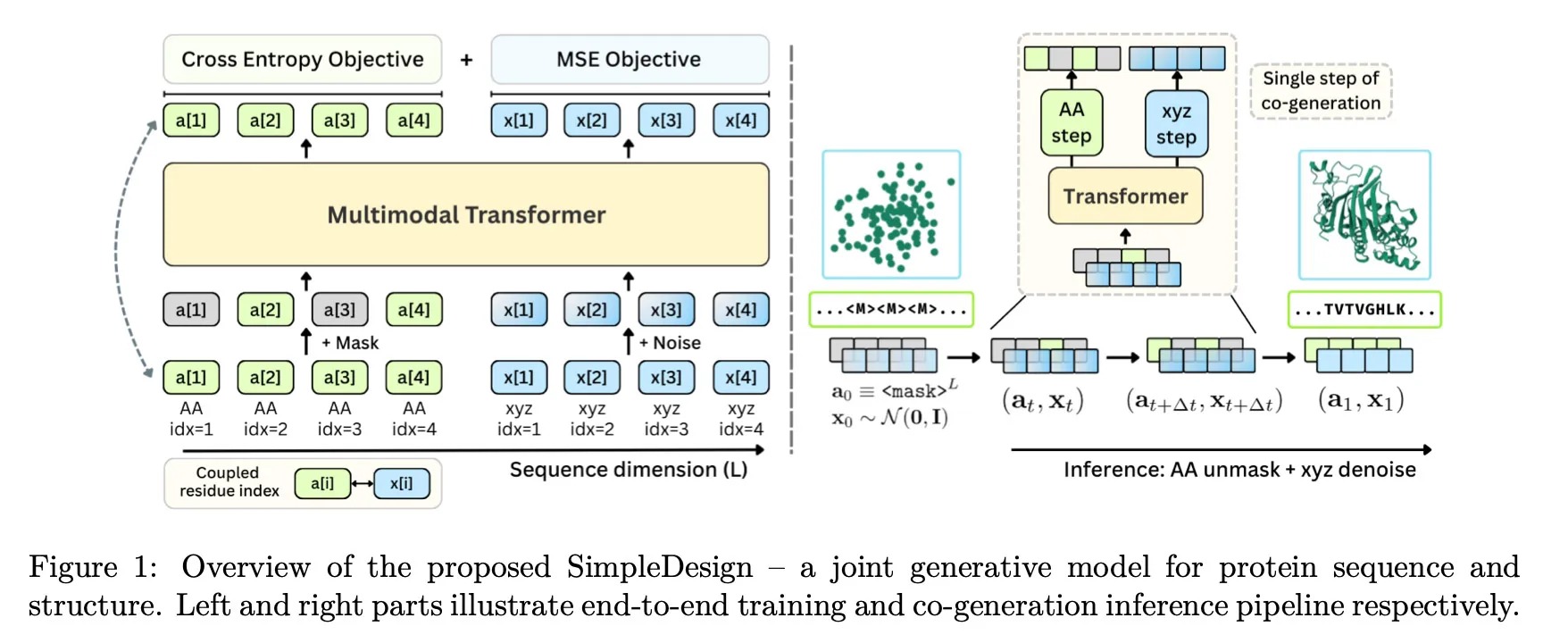
By adjusting the degree of corruption to sequence and structure, the model can learn different protein tasks. When the sequence is largely intact but the structure is heavily perturbed, the task resembles protein folding - recovering structure from a known sequence. When the structure is largely intact but the sequence is heavily masked, it resembles inverse folding - generating sequences that would form a specified structure. When both sequence and structure are partially corrupted, the model must jointly handle both types of information, learning the coordinated design of protein sequence and structure.
Competitive results, but lab validation still pending
According to the research findings, SimpleDesign achieved competitive performance on benchmarks for joint protein design, structure generation, and sequence generation. The researchers also found that the model can generate protein structures with plausible morphology, and the overall quality of generated amino acid sequences is comparable to or better than most competing multimodal models.
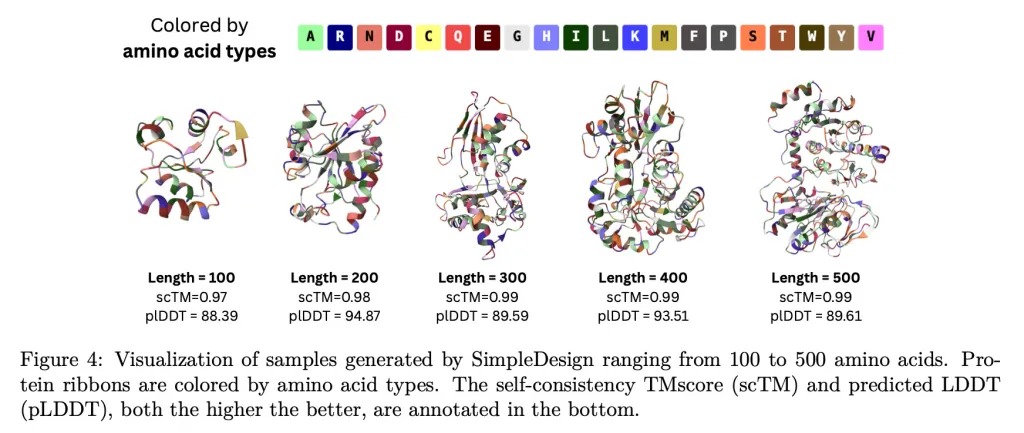
However, the paper currently reports only computational evaluation results. The research team has not yet experimentally verified whether the generated proteins can actually fold, function, or operate safely in biological systems, so the results cannot yet directly demonstrate that the model's designed proteins have real-world applicability.
The publication follows a pattern of Apple expanding its AI research into scientific domains. While the company has not announced any commercial application for SimpleDesign, the work signals growing interest from major tech firms in using generative AI for protein engineering, a field with potential implications for drug discovery, enzyme design, and materials science.
Based on reporting by IT之家. Edited and published in English by geisou.